What is the "stretched/relaxed" state of curly hair?


The stretched state of curly hair is when the curls are relaxed and stabilized in this state in a temporary manner.
Curls relax with good hair hydration and nourishment
Curly hair can pass:
- from a curly to a frizzy state with a simple detangling.
- from a curly or frizzy state to a locked (locs) state by letting the curls knot or by tying them,
- from a stretched/relaxed state to a curled state thanks to water/humidity,
- from a curly state to a straight state by stretching the hair with thread, elastics, nourishment and hydration, or heat,
- from the curled state to the looped state by defining the loops.
Thanks to the natural versatility of curly hair , we have a choice between different looks depending on our daily routines, our care choices, our desires, our lifestyles and our cultures:
- the locked/locs state (tangled loops),

- the looped state (natural loops defined),


- the frizzy state (disjointed curls),


- the stretched state (relaxed curls).


1. How to relax your curls through nutrition and hydration?
Hydration and oily treatments can weigh down curly hair, making it softer and slightly wavy.


To maintain wavier curls , it is important to combine hydration and nourishment of the hair.
Vegetable butters and oils nourish dry hair and add weight to slightly loosen curls.
For those who naturally have oily hair , hair sebum plays this role, and an appropriate dose is enough to maintain the wavy effect without weighing it down unnecessarily.

To hydrate hair, water—preferably free of limescale—may suffice. However, it is possible to create lotions by adding plants or oils, depending on their properties and individual hair needs.
To prevent rapid evaporation of water in the hair, especially depending on different climates, a humectant (for example: vegetable glycerin, honey) can be added to this water, for its ability to retain and attract moisture from the surrounding air or water.
This allows curly and dry hair to remain more hydrated, more supple, and sometimes heavier — vegetable butters or oils also help to loosen the curl.

Examples of dosages for a homemade lotion with a humectant:
🌸 1. Moisturizing lotion with vegetable glycerin
Ingredients (per 100 ml of lotion):
90 ml of mineral water or hydrosol (without limescale)
5 ml of vegetable glycerin (i.e., 5%)
4 ml of light vegetable oil (jojoba, grapeseed, or argan — optional)
1 ml of Cosgard (0.6 to 1% of the total, i.e. approximately 20 drops per 100 ml)
Preparation :
Pour the water (or hydrosol) into a clean spray bottle.
Add the vegetable glycerin and mix gently.
If you want, add the vegetable oil and shake well.
Finish with the Cosgard, mix again.
Use :
Shake before each use (as the oil may separate).
Spray on damp or dry hair, especially on the lengths and ends.
Use 1 to 2 times a day maximum , glycerin attracts moisture: avoid if the air is very dry (risk of drying instead of moisturizing).
Conservation :
Maximum 3 months at room temperature, away from heat and light.
🍯 2. Honey Moisturizing Lotion
Ingredients (per 100 ml of lotion):
90 ml of mineral water or floral hydrosol
5 ml of liquid honey (approximately 1 teaspoon)
4 ml of light vegetable oil (optional)
1 ml of Cosgard (preservative)
Preparation :
Warm the water slightly to help dissolve the honey.
Mix the water and honey until the texture is smooth.
Add the vegetable oil (optional) then the Cosgard.
Pour into a spray bottle.
Use :
Shake well before use.
Spray onto damp hair after washing or as a daily treatment.
Honey is an excellent natural humectant and adds shine , but it can slightly weigh down fine hair: adjust according to your hair type.
Conservation :
3 months maximum at room temperature (thanks to Cosgard).
2. How to temporarily relax or stretch your curls using massage?
Several methods exist to temporarily loosen curls:
- A. Loop Disunification
Use a comb or brush to separate the curls.
Ideally, work on slightly damp hair to limit breakage and reduce shrinkage (the natural shrinkage of curly hair).

Example:
Before untangling


After detangling

Effect of loop size
The smaller the curls , the greater the volume will be, and the apparent length will increase after detangling, depending on the natural condition of the hair.
Conversely, the larger the curls , the less noticeable the volume will be and the length added when detangling will be less, because the hair will tend to fall out more .

- B. Braids, twists or twists
On damp hair , create braids, twists or twists .
Once the hair is dry , undo the hairstyles after a few minutes or a few hours depending on the desired effect.
This method allows you to relax the curls while maintaining a wavy shape.
Example of results with "cornrows" (corn-style braids) 
Example of results with braids

Example of results with twists/vanillas

Example of results with "glued"/"lying" vanilla/twists (Flat Twists in English)

- C. Braids using threads, strings, ribbons, or the elastic band technique
Create braids using threads or the elastic band technique to stretch the loops.
Leave on for the desired time, then undo the braids to obtain a relaxed or wavy effect.
Example of results using the rubber band technique 


Example of results with braided yarns:


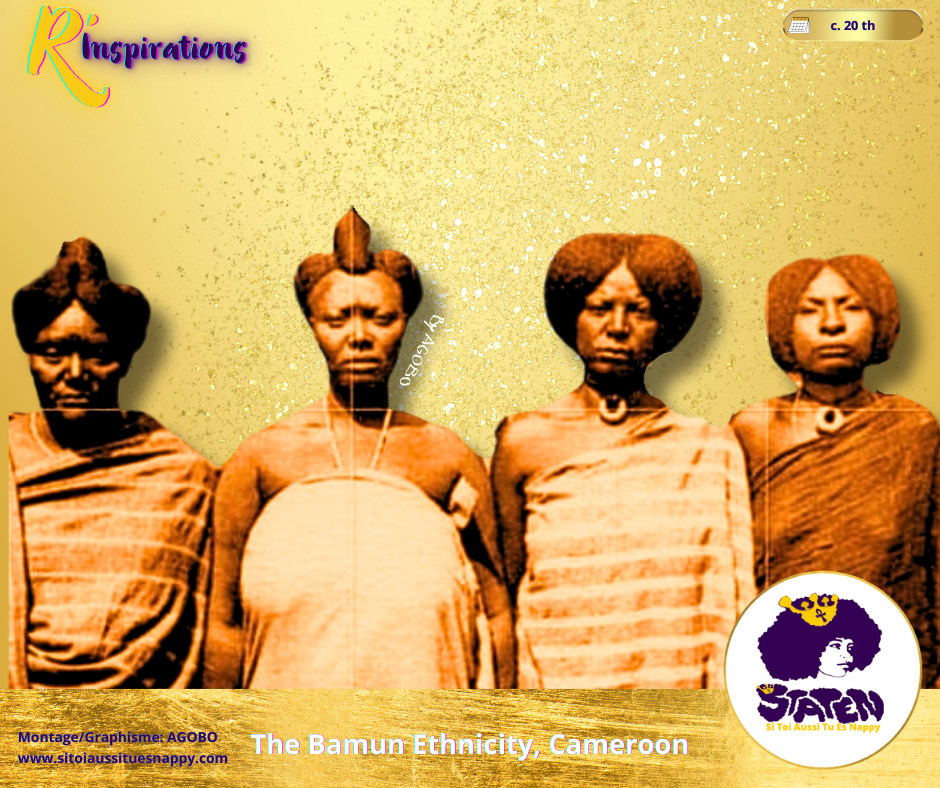
Many communities have used these techniques for centuries to create their traditional hairstyles , without seeking to reveal the actual length of the hair , nor to leave it loose or to straighten it.
Here are some examples with images of the Akan people and their various ethnic subgroups from Ghana and Ivory Coast , taken at different times.


Many African peoples practice thread braiding as part of a cultural practice.
Here are some illustrative examples.


Natural curly hair offers a multitude of hairstyles , regardless of the type of curls or their condition.
This is a wonderful opportunity to vary the styles!
STATEN