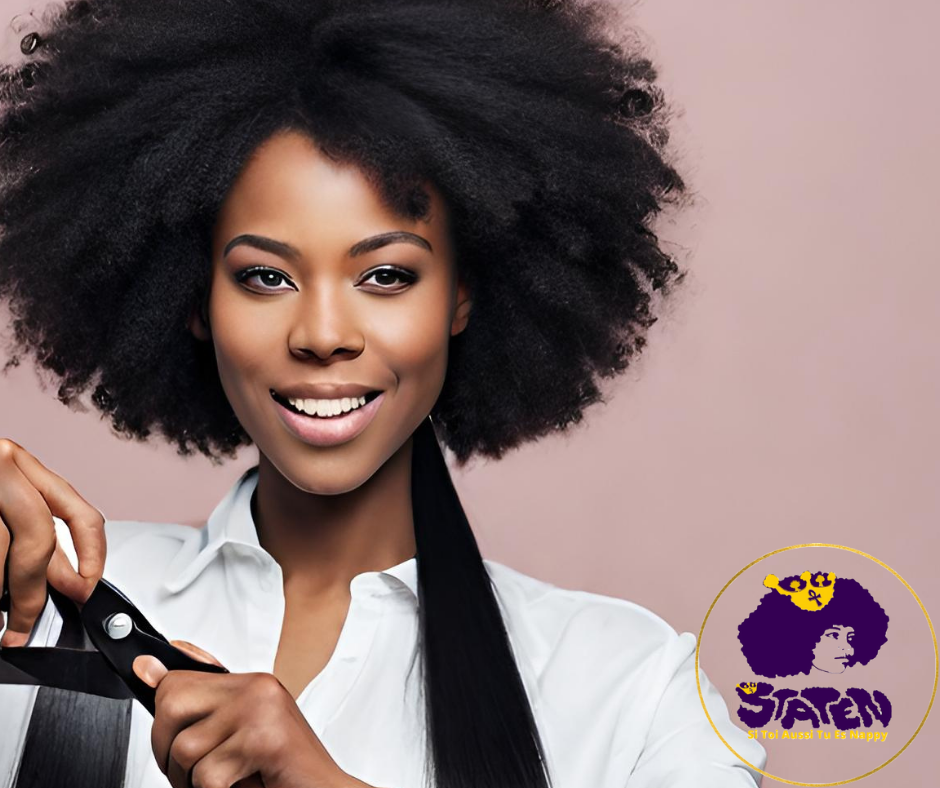
Back to natural hair
📄 What is hair transition?


Hair transitioning is one of the possibilities for returning to natural hair for people who had relaxed hair before the BIG CHOP stage.

Hair transitioning involves letting your natural hair grow to a desired length while keeping the chemically treated, straightened ends. This transition allows for a smooth adjustment, giving you time to reflect on your choices and perhaps even find the courage to cut off the chemically treated hair.
In order to regain her natural appearance, her natural hair, to have healthier hair, to no longer put dangerous chemicals causing certain diseases in her body or to be a physical model of the beauty of the natural black woman for her children.
But there are two types of hair to manage that require different care and actions: Healthy natural hair with healthy roots and your ends that have been chemically or heat-treated (straightening, relaxing, bleaching or coloring etc...).


The hair transition is a gradual process; you have time to choose your desired natural hair length before starting. However, it requires a lot of patience, as chemically straightened and damaged hair slows its growth. Furthermore, shrinkage (the reduction in the size of the curl pattern and natural spring) makes curly hair appear shorter than it actually is. This shrinkage can be quite noticeable depending on the curl size and can create the illusion that the hair isn't growing.


And for people transitioning who don't know their natural hair, this allows them to gently learn to understand and manage their curls. They have to let go of the habit of having relaxed hair that shows the true length but only offers a possibility of achieving it.

The hair transition also allows novices to learn how to manage the natural versatility of curly hair. We have the natural choice between a curly state (defined curls), a frizzy state (loose curls), or stretched hair (relaxed curls) depending on our actions.


During the transition, some people don't need to cut their relaxed hair because it's broken or damaged. Relaxed hair is drier, thinner, damaged, burnt, and fragile, requiring extra care to survive despite the damage. In these cases, people simply trim the ends to even it out and remove the remaining damaged hair.

There are also those who prefer more freedom and a wider range of hairstyles, no longer wanting the upkeep of relaxed hair and the management of two textures. These people cut their hair every few days or even a few years, depending on their preference.
If the person has never known their natural hair since childhood, they must learn how to care for curly, frizzy hair.


In terms of appearance, it is difficult for many people in transition to let their hair flow freely according to certain aesthetic criteria, given that the roots are curly and the ends are straight.

Hair in transition is often straightened.

Hair in transition is also curled with techniques like twist out or braid out, etc., to achieve a uniform appearance.

However, straightened ends are often thinner than natural hair, and straightened hair breaks despite care. Therefore, hair doesn't always look the same. Some people trim the ends over time, while others let their hair break naturally.
In terms of hairstyles, hair in the transition phase is also braided.

hidden or camouflaged during the transition.

Sometimes, when the transition is too long and the person changes hairstyles one after another without taking the time to let their hair grow naturally and learn how to care for it over time, they find themselves lost or overwhelmed when they decide to learn how to do it themselves. Because their hair is voluminous, shrinkage isn't managed, and they don't know their own hair. These people find daily routines and care too difficult due to a lack of experience.

Very often, these people have not learned to see each other on a daily basis. With their natural, loose hair , sometimes they don't feel beautiful with their natural hair. This type of person prefers their hair with braids, straightened hair, or wigs, etc... ultimately.

These people often have beautiful, long, and voluminous natural curly hair, given the very long transition period. And there are countries where finding an inexpensive hairdresser is so easy that some people don't take the time to learn.

They don't yet know how to manipulate them, how to maintain them without creating difficulties in their lives.

It's important to dare to take the plunge and do the Big Chop to avoid falling into this kind of trap. Hairpieces are styling options that reflect our moods and desires. They are not a necessity or obligation for Black women to wear in order to be beautiful or feel beautiful, as some would have us believe. It's important to remain independent and free to be ourselves physically.
It takes a certain amount of courage and mental strength to dare to do your Big Chop, especially if you're used to having long hair and don't have much natural hair length.

Cutting one's hair short can be a shock. During the adjustment period, women/girls may sometimes feel depressed or regret their actions and resort to artificial means (scarves, wigs, etc.) while waiting for their hair to grow back. The shock is less severe than a Big Chop Radical.


What's normal is that the Big Chop involves physical change, abandoning an appearance that has often defined us since childhood. The Big Chop marks the end of a chapter in our lives. It makes us leave behind a lifestyle; some people felt good about straightening their hair, it was like applying a hair mask, despite the burns and the known or unknown health risks.
Hair straightening and smoothing were part of their upbringing, and they shared moments with our mothers, grandmothers, sisters, cousins, nieces, friends, etc. We had the feeling that we had done something to be beautiful, passed down from generation to generation. We learned to straighten our hair like we teach a young girl how to care for it.
After the Big Chop, you also have to deal with the shock, the incomprehension and prejudices in your surroundings sometimes, or the encouragement, motivation, and compliments also depending on cultures, education or traditions.
Hopefully this will help you make a choice or better
understand some steps of returning to natural hair.
Queen STATEN